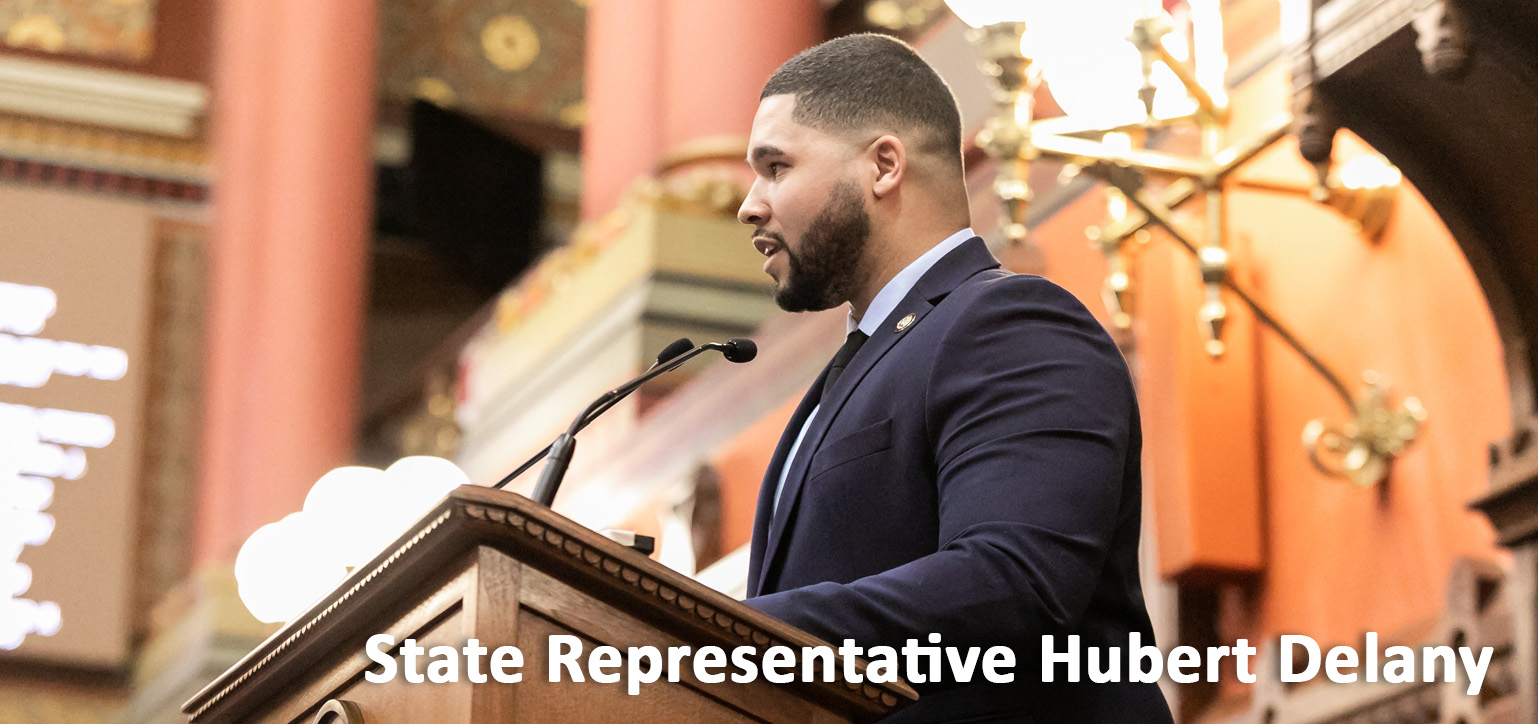
Legislative Update April 2nd

April 2, 2026


View this email in your browser

Dear Friends and Neighbors,

Spring is here, and with it comes a season of renewal, reflection, and hard work. As many in our community observe Holy Week, Passover, and Easter, I want to extend my warmest wishes to all who are marking these sacred and meaningful holidays. This is a time when families and communities come together in faith, remembrance, and hope, and I wish peace to all who are celebrating.

At the Capitol, the 2026 Legislative Session is still in full swing. It has been a productive several weeks as my colleagues and I continue working on the issues that matter most to Stamford and communities across Connecticut. The House convened on Wednesday, March 25th, to vote on judicial appointments and a contract between the state and the Connecticut Employees Union Independent. With most committees having completed the bulk of their work, we are now entering the next phase of session, where House leadership will determine which bills move forward for debate and vote before the session concludes in May.
 
Over the coming weeks, we are preparing for more days in session and more opportunities to deliver real, meaningful results for our residents. I remain committed to fighting for a state government that works for the people with fairness, compassion, and purpose.
 
As always, thank you for staying engaged and informed. I will continue to keep you updated on the work we accomplish in the weeks ahead. If there is anything I can do to be of service to you or your family, please reach out to my office at 860-240-8585 or email me at Hubert.Delany@cga.ct.gov.


Hubert Delany
 

Advocating for Increased Education Funding

Earlier last month, House Speaker Matt Ritter, Majority Leader Jason Rojas, and members of the House Democrats held a press conference to advocate for increased education funding for cities and towns across Connecticut. 

House Democrats are proposing to use a portion of the state’s projected surplus to provide $100–$170 million in one-time support to municipalities. This investment would help schools meet rising costs while easing pressure on local property taxes, providing important relief for both municipalities and residents.

Our goal is to deliver more education funding to our municipalities to support our kids and provide tax relief.
 
By prioritizing student needs, this plan could bring a 2%–5% increase in Education Cost Sharing (ECS) funding to communities like Stamford. That support will help our schools manage rising costs, invest in student success, and reduce pressure on local taxpayers.

This support would be in addition to our current education funding and is intended to ease budget pressures, helping our towns avoid property tax increases while stabilizing local finances and supporting our schools. 
 
I strongly support the efforts of Speaker Ritter, Majority Leader Rojas, and the rest of my House Democratic colleagues. We do have more work to do, but this is an important step toward giving every child in Stamford and across Connecticut the resources and opportunities they deserve. 
 

Protecting Connecticut Residents from Federal Overreach

The Judiciary Committee recently voted to advance legislation that would expand restrictions on where Immigration and Customs Enforcement (ICE) agents can operate in Connecticut. The bills would prohibit ICE from entering places of worship and hospitals, ensuring that our residents are not afraid to seek medical care or practice their faith. As I said during the Committee's deliberations, Connecticut is already one of the safest states for immigrants in the country, and we do not need the federal government's heavy-handed enforcement tactics to keep our communities safe. Attorney General William Tong has voiced his support for these measures, noting that immigrants and their families have a right to be protected from violence and intimidation.

Earlier in the month, the Committee also held a public hearing on several bills aimed at increasing state oversight of federal law enforcement officers, including S.B. 91 and S.B. 397, which would expand the definition of "peace officer" under state law to cover all federal law enforcement agents — not just those dealing with narcotics. Connecticut Inspector General Eliot Prescott testified that the state has a broad sovereign interest in ensuring that all officers, including federal agents, comply with Connecticut law. While these proposals continue to be refined, the Committee is committed to ensuring Connecticut has the tools it needs to hold everyone accountable under the law. 
 

Blue Collar Caucus Legislative Priorities

Last Wednesday, March 25th, I joined House members for a press conference outlining the Blue Collar Caucus legislative priorities, including legislation focused on Artificial Intelligence protections. This bipartisan caucus is focused on the issues that matter most to working and middle-class families across Connecticut and is committed to supporting workers in every sector with job training opportunities, worker protections, and policies that put hardworking families first.

This legislative session, priority bills are focused on workforce development, first responder protections, healthcare, affordability, consumer protection, education, and trades. In terms of AI, we have seen that it is already shaping the lives of working and middle-class families, from the information collected about them to the decisions that affect their work and economic security. We have a responsibility to ensure these systems are met with transparency, human oversight, and accountability. These bills are about protecting workers and consumers alike, while building the public trust necessary for responsible innovation.

Watch my remarks during the press conference below. 
Blue Collar Caucus Press Conference
 

Black Legislative Advocacy

To pass meaningful laws, we need meaningful engagement from the community. That is why I was honored to join the National Coalition of 100 Black Women, the 100 Black Men of Stamford, and the NAACP of Stamford for their recent Legislative Breakfast.
 
It was an important opportunity to be in conversation with community leaders and advocates who care deeply about the future of our state and the well-being of our people. We had serious and thoughtful discussions about the future of education, housing, opportunity, and what it means to advocate with real purpose for the Black community in Connecticut.
 
Gatherings like this matter because strong communities help shape strong policy. Democracy is at its best when community organizations show up informed, organized, and ready to engage on the issues that affect their neighborhoods and families. Our government is better when people bring their voices, their experience, and their expectations directly into the conversation.
 
I am grateful to these organizations for their continued leadership, their partnership, and their commitment to making sure the needs and priorities of the Black community remain front and center.
 

Jack and Jill of America Advocacy

Last month, we welcomed Jack and Jill of America, Inc., Stamford/Norwalk Chapter to the State Capitol.
 
This visit was especially meaningful to me because I am a graduate of this chapter myself. Organizations like Jack and Jill played an important role in my own development, helping to build confidence, expand opportunity, and reinforce the value of leadership, service, and excellence at an early age.
 
That is why opportunities like this matter so much. When young people visit the Capitol and see government up close, they are reminded that leadership and public service are not distant concepts. They are real pathways that they, too, can pursue.
 
I also want to thank State Representative Corey Paris and State Representative Matt Blumenthal for joining us and for their fellowship during the visit
 

Read Across America

Earlier this month, I had the opportunity to visit Newfield School and spend some time reading with the students during Read Across America. We read The Lorax and The Wonderful Yet and had some great conversations about hope, mentorship, and believing in yourself.
 
Events like these mean a lot to me. I’m only where I am today because I had opportunities growing up to meet mentors and experience moments like this that helped me believe in what was possible.
 
Thank you to the teachers and staff at Newfield for the warm welcome, and to the students for such great questions and energy.
 

CIF Funding Approval for Stamford

Last week, the Community Investment Fund (CIF) approved funding for three different projects in Stamford. These critical investments will strengthen early childhood education, expand substance use treatment, and advance affordable housing.

The projects include: 

  • $7 Million for Children's Learning Centers (CLC) of Fairfield County: for the Grover Head Start Facility of CLC to support renovation of an existing building and construction of an addition to house CLC's Head Start program, consolidate administrative and operational functions, and expand outdoor learning spaces. The Grove would serve as a hub for Stamford's young children and their families, offering free nature playdates, family events, and fee-based programs like summer camps and caregiver-child classes.
  • $6 Million for St. John Urban Development Corporation: for the demolition of St. John Towers. The funding would complete extensive abatement and demolition of the St. John Towers property in Stamford and prepare the site for affordable housing redevelopment.
  • $250,000 for Liberation House, Inc.: for the renovation planning at Liberation House, Inc. to accommodate new residential treatment services. 
These recommendations still require final approval from the State Bond Commission.
 

Free Tax Assistance Services

With the tax deadline approaching on April 15th, now is the time to take action if you haven’t filed yet. There are several free resources available this year for anyone who needs to file state and federal taxes.

The Volunteer Income Tax Assistance (VITA) Program offers free tax help for low-to moderate-income (under $58,000) people who cannot prepare their own tax returns. Volunteers, sponsored by various organizations, receive training to help prepare basic tax returns in communities across the country. Visit Connecticut's 2-1-1 website and the Free Tax Help page for VITA assistance updates, or visit the IRS Site Locator

AARP's Tax-Aide Program, a partnership between the AARP Foundation and the Internal Revenue Service, provides free tax counseling and preparation services to middle-and low-income taxpayers, with special attention to people age 60 and older. Many sites will e-file your federal and Connecticut returns at no cost to you. Visit the AARP Tax-Aide Site Locator to find a location near you. 
 

The UConn Law School Tax Clinic is a pro bono (free) legal clinic that provides free legal help to low-income taxpayers with tax problems, either with the Internal Revenue Service (IRS) or the Connecticut Department of Revenue Services (DRS). Lisa Perkins, Clinical Professor & Director, and law students will work on your case. The Tax Clinic also works with attorneys in Connecticut who volunteer to help low-income taxpayers pro bono. The Tax Clinic is independent and separate from the IRS and DRS. It is important to note, that the UCONN tax clinic is only able to assist individual taxpayers with Connecticut income tax problems. Contact Lisa Perkins at lisa.perkins@uconn.edu or 860-570-5165

Here in Stamford, residents can receive free tax assistance through the Ferguson Library. Now through April 15th, AARP tax counselors will be available at Ferguson Library branches throughout the city. Visit the Ferguson Library calendar for available dates and visit the library page on Income Tax Resources for additional information. 
 

Student Loan Reimbursement Program

Connecticut residents who made student loan payments last year can apply for assistance now. The Connecticut Student Loan Reimbursement Program has opened a new round of grants to provide financial relief to eligible residents across the state. 

This program offers critical support to many younger residents and middle-income households who are working to manage the rising cost of education while building their careers and families in Connecticut. By helping offset student loan payments, the program eases financial pressure and allows participants to focus on long-term stability and opportunity.

Just as importantly, this initiative plays a key role in retaining home-grown talent here in Connecticut. By encouraging graduates to stay, live, and work in our state, the program strengthens our workforce, supports local economies, and ensures that Connecticut continues to benefit from the skills and dedication of its own students.

Eligible applicants must have graduated from a public or private college or university in Connecticut and must be a Connecticut resident for at least five consecutive years. 
Click here to view eligibility requirements

Applicants may qualify for reimbursement grants of up to $5,000 per year, with a maximum of $20,000 over four years. Each year, the program opens a new grant cycle to reimburse student loan payments made during the previous calendar year. 

You must submit an application online through the CT Scholars portal along with the required documentation. CLICK HERE for step-by-step instructions.

If you have any questions or need assistance, please contact the Connecticut Office of Higher Education at OHE.SLRP@ct.gov

Applications will be reviewed on a first come first serve basis through December 2026 or until funds are exhausted.
 

Omnibus Bill: A Closer Look

Last month, my colleagues and I passed S.B. 298 - a sweeping omnibus bill - into law, and I want to share some of its highlights.

Part of that bill includes a number of education provisions that passed by a wide margin in the House last year, and unfortunately was not voted on in the Senate.
 
One part of it improves the state’s practice of crisis response drills to improve students’ physical safety and properly balance their psychological well-being.

While schools must be prepared for an emergency, organizers must ensure these drills are conducted effectively and responsibly.

Another section creates a state seal of civics education and engagement to be earned on high school diplomas for students who demonstrate civics mastery in the classroom and community engagement.

At a time when civic engagement is alarmingly low in our country, this recognition will encourage students to learn more about the way our government works and the role they play in shaping society.

This seal also sends a powerful message that civics isn't just a class to pass; it's a way to make a difference and give back to your community. 
 
Other key aspects of this bill include:

  • Addressing antisemitism in schools
  • Adding additional public reporting on student outcomes for our multi-lingual learners
  • Providing curriculum on Islamic and Arab Studies
  • Phases out the waiver for children under the age of 5 to begin kindergarten early.
  • Raising the standard for when a student in pre-K to grade 2 can get an out-of-school suspension
  • Requiring same-day notification of any use of restraint or seclusion of a student.

The legislation we passed is an important bill that encourages civic engagement and protects our students' mental health. 


Website
Website

Email
Email

Forward to a friend | Unsubscribe from this list | Update subscription preferences